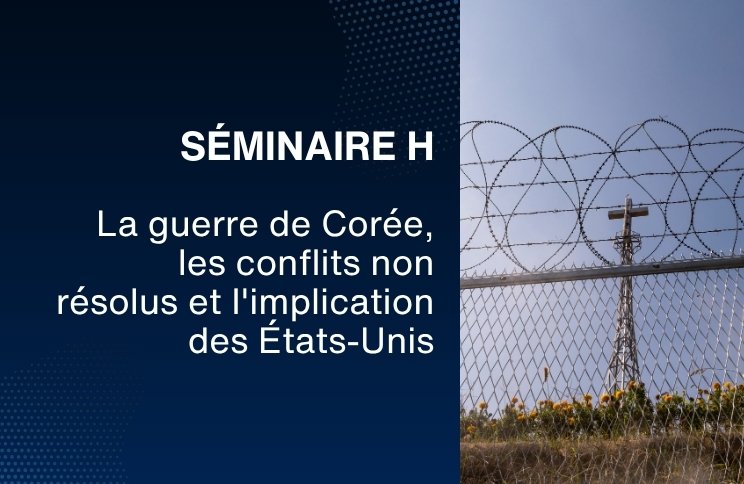
The Korean War, Unresolved Ongoing Conflicts and US Involvement
Seminar Description
The Korean Peninsula remains one of the most heavily militarized regions in the world, its division a lasting symbol of Cold War politics. Although the Korean War (1950–1953) ended in an armistice, no peace treaty was signed, leaving the conflict unresolved and ongoing. Today, the United Nations Command remains in South Korea, U.S. military bases have been fortified, and joint U.S.–South Korean military exercises continue to shape the region’s security landscape.
This seminar examines the Korean War and its aftermath through the lens of international law, human rights, and the right to peace. Topics include the role of the UN Command in South Korea, the U.S.–South Korea military alliance, and struggles against mandatory conscription, including conscientious objection and resistance to militarism. Faculty also analyze the implications of the UN Charter, General Assembly resolutions, and the UN Flag Code for understanding U.S. imperialism on the Korean Peninsula.
Seminar Content
Examine the geopolitical landscape leading to and stemming from the Korean War.
Explore forward-looking approaches to ending the conflict.
Analyze legal implications of the U.S.’s use of the UN flag.
Assess the legal principles behind and the use of contentious objection in the Korean context.
Faculty
Peter Kuznick
Professor of History and Director of the Nuclear Studies Institute at American University
Lee Jang Hie
Professor Emeritus at Hankuk University, Judge of Permanent Court of Arbitration, Hague
Lee Si Woo
Photographer, Expert on the Legality of UN Command and Flag
Lee Kyong Ju
Constitutional Professor at Inha University Law School
Marjorie Cohn
Moderator, Dean of the People's Academy of International Law
Supreme Court en banc Decision 2016Do10912 Decided November 1, 2018 [Violation of the Military Service Act] (holding that the Defendant, a Jehovah’s Witness, was based on a “justifiable cause” under Article 88(1) of the Military Service Act)
Opinion submitted to the Supreme Court of Korea by Amnesty International Korea in 2018
Social Share
Thank you for registering for the People’s Academy! In the future, you will be auto-registered for future courses and seminars. Please manually register for the upcoming program:
The Struggle Against the International Assault on Labor Rights